
This reporting was supported by the International Women’s Media Foundation’s Lauren Brown Fellowship.
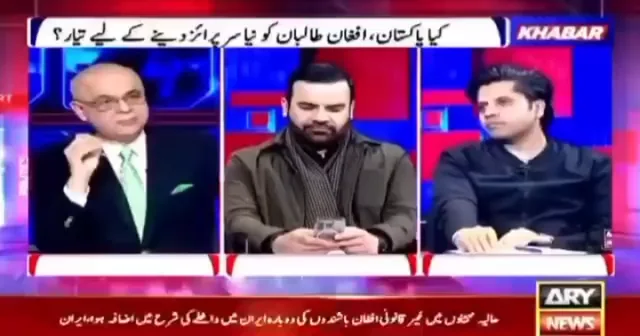
Islamabad – Shafiullah Jan, special assistant to the Khyber Pakhtunkhwa (KP) chief minister, appeared to refuse to categorically label the banned Tehreek-e-Taliban Pakistan (TTP) a “terrorist organization” in an interview with a national news anchor last week – drawing sharp criticism from opponents, activists and media commentators.
At a press appearance this week, federal Information Minister Attaullah Tarar played a video clip in which Jan was asked whether the outlawed TTP is a terrorist group. Jan declined to give an unequivocal “yes,” saying “there are groups within the TTP and those who are against the state are terrorists.”
The federal minister seized on the remarks, accusing Jan and the Pakistan Tehreek-e-Insaf (PTI) of soft-pedaling Pakistan’s insurgent threat and extended an “olive branch” to militants.
“The spokespersons of the political party are afraid of talking about the terrorist group,” Tarar said, claiming that PTI leaders fear being attacked by the TTP and therefore won’t condemn them outright.
The comments reignited long-standing debates in Pakistan about counterterrorism, messaging and political strategy — and drawn fire on social media from journalists and activists.
“Inexcusable behavior. You cannot complain or clutch pearls about being smeared as terror sympathizers when your own government’s spokesman can’t muster the bare bones clarity or spine to call the mass murdering butchers of TTP a terrorist group,” wrote activist Ammar Rashid on X.
Raza Haroon, a former provincial minister, wrote: “#PTI appears visibly confused and lacking clarity. Today, the party’s Secretary General, @salmanAraja, categorically acknowledged the #TTP as a terrorist organisation, ironically on the same show..”, adding, “This only exposes the party’s persistent policy incoherence and internal contradictions.”
Some commentators also mentioned older controversies around incarcerated former premier Imran Khan’s statements on militant figures.
In June 2020, Khan drew international and domestic rebuke when he used the Urdu word “shaheed” (martyr) to describe slain Osama bin Laden during a National Assembly speech – language critics said blurred the line between strategic critique of U.S. foreign policy and reverence for a globally designated terrorist.
Opposition leaders at the time said bin Laden was “a terrorist through and through,” pointing to the attacks he orchestrated at home and abroad, including against Pakistani citizens, and questioning the prime minister’s choice of words.
The TTP has been proscribed in Pakistan for years and is widely accused of orchestrating deadly attacks across the country, particularly in the north-west.
Against that backdrop, critics argue that any ambiguity in public rhetoric undermines counterterrorism efforts and emboldens extremist narratives.
Political rhetoric that fails to clearly denounce militant groups like the TTP is problematic because it dilutes public understanding of the threat the group poses and weakens a unified national response to ongoing violence, including numerous recent attacks the TTP has carried out in Pakistan.
Ambiguous language from political figures, especially when they avoid plainly calling an active militant group a terrorist organization, can create confusion among citizens about who is a threat and why, making it harder to sustain broad support for the hard security and legal measures needed to counter the challenge, especially given that there has been a resurgence of the TTP threat recently.
Analysts and security experts have noted that shifting or evasive narratives around the TTP have left the Pakistani public “poorly informed and confused about the nature of the threat,” and have at times emboldened the insurgents by suggesting there might be political space for negotiation without accountability, a distinction crucial for effective counterterrorism policy and public resilience.
This ambiguity also has real implications for national cohesion and counterterror strategy. When elected officials hedge on defining terrorism, it can erode confidence in government commitment to security policy, weaken cross-party cooperation on counterterrorism, and even be exploited by militants in their propaganda, which actively seeks to shape narratives in their favor.
Such rhetoric risks normalizing extremist violence in public discourse and undermines long-standing frameworks like Pakistan’s National Action Plan, which was built on broad consensus to crack down on terrorism and eliminate proscribed organizations.

The writer is an Assistant Editor at Dissent Today, focusing on extremism and political violence.

