Sunday, February 8, 2026
HomeOpinionIn Islamabad, State's Apathy on Full Display as Baloch Families Hold...

In Islamabad, State’s Apathy on Full Display as Baloch Families Hold Protest Camp

Published on

Imaan Zainab Mazari-Hazir
The writer is an Islamabad-based lawyer and human rights activist.

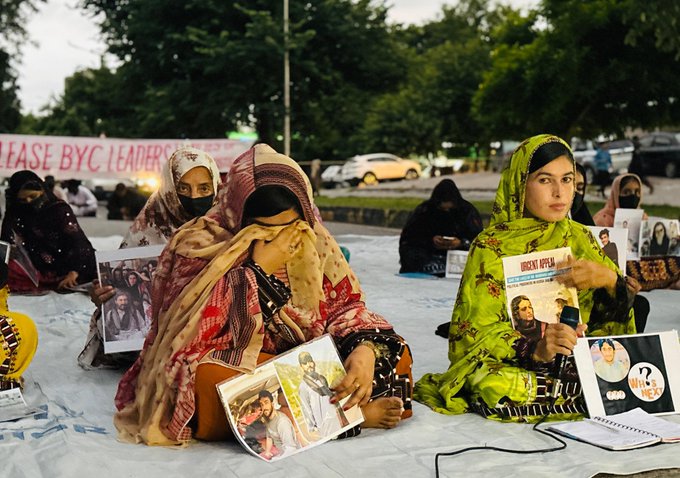
Human rights lawyer Imaan Mazari writes about Baloch families — particularly women, children, and the elderly — who have been camped outside Islamabad’s National Press Club for over a month, demanding accountability and justice in the face of enforced disappearances and the culture of impunity in Balochistan. 


“Will anyone come? We have been waiting for so many days,” asked a Baloch mother, grasping my hand in hope of good news. Another mother, Zar Gul, whose son Saeed Ahmed was forcibly disappeared in 2013, joined in, holding my other hand and saying, “Maybe this time we’ll bring our sons home.”

These past fifty-plus days in Islamabad have been an emotional whirlwind for anyone visiting the Baloch families’ camp near the National Press Club in F‑6 sector. The women’s stories are so harrowing that they often collapse while recounting their ordeal — seeing their sons abducted by plainclothes men who broke into their homes; enduring ten years of agonizing waiting, searching for answers in courts and on the streets; holding fifteen years of hope that their brothers remain alive as they were when taken before their eyes.

The Baloch National Movement’s human rights department, Paank, reported that in the first half of 2025 alone, 785 cases of enforced disappearances and 121 extrajudicial killings were documented.

The Defence of Human Rights has documented 3,140 cases since 2006, with 1,362 victims still missing. In 2025, 32 new cases were reported.

Only the families enduring this cruel, collective, and relentless punishment truly understand what each second of the day feels like. Their cries seem to go unheard in the corridors of power just streets away — no government minister has visited the camp to date. This government’s apathy is so stark and the war on its citizens so brazen that even the fiction of engagement with these elderly women and young girls has been abandoned.

The callousness is further illustrated by the authorities’ refusal to allow the peaceful protesters to set up camp for shelter outside the Press Club. Much like they are caged in Balochistan, these women are now confined to a narrow road, surrounded by barriers and barbed wire — a chilling reminder of that treatment during the 2023 Baloch long march to Islamabad.

During the freezing winter of 2023, many of them were attacked with water cannons and sticks as they peacefully protested. Many, including young Mahzaib (niece of forcibly disappeared Rashid Hussain), were unlawfully arrested, detained, and loaded into buses to be forcibly sent back to Balochistan.

Although the Baloch Yekjehti Committee has made significant strides in advocating for human rights, its impact has been severely hampered by the detention of its leadership, most notably Dr. Mahrang Baloch, its founder and a globally recognized human rights activist.

Dr. Baloch has now been detained since March 22, following a peaceful sit-in protesting state violence.

Her imprisonment has deeply affected the community. Elderly mothers at the protest camp have shown me photographs of their sons and said, “Mahrang raised her voice for them. Now, we will raise our voice for Mahrang.”

Moreover, almost the entire leadership of the Committee is now behind bars. This includes Sebghetullah Shah Jee, Beebarg Baloch, Beebow Baloch, and Gulzadi Baloch.

The legal process surrounding these detentions reflects a persistent pattern of arbitrary and prolonged incarceration. The authorities have repeatedly invoked the colonial-era Maintenance of Public Order (MPO) law — originally enacted in 1960 — allowing detention without formal charges. Even when the judicial system convenes hearings, the prosecution repeatedly fails to present credible evidence, yet the detainees remain imprisoned.

These women and girls are not just here for their loved ones – they are here to demand the release of those brave leaders who carried the grief of the Baloch people on their shoulders. They remember the Long March with Dr. Mahrang to Islamabad in 2023.

Though the state succeeded in breaking the hope of many — as seen in the much smaller number who returned this year — even the stubborn hope held by these few women sends a powerful message to the people of Pakistan: no matter how heartless the state’s response, the path of peaceful resistance must not be abandoned.

Passersby often approach the camp and ask, “Why have they been sitting here so long? Has anyone from the government come to speak to them yet?” When told that no one has come despite more than a month of protest, through scorching heat and torrential downpour, they merely sigh and move on. But these women cannot move forward, as their lives remain forever suspended.

There is no doubt that enforced disappearances are Pakistan’s greatest crisis — the clearest indication of a total breakdown in rule of law in a society that tolerates this atrocity. Impunity is entrenched: not a single perpetrator has been identified or brought to justice.

Worse still, impunity has grown in recent months, especially since the 26th Constitutional Amendment. 

Baloch families have always faced significant challenges in registering cases for crimes committed against them. But following recent amendments, police have begun to outright refuse the registration of abduction First Information Reports (FIRs) — even when the Islamabad High Court is actively hearing a habeas corpus petition or has issued a court order.

Habeas corpus petitions, which were once heard promptly — often the same or next day — are now delayed due to frivolous administrative objections, even when hearings are scheduled. New judges at the Islamabad High Court have started to decline directing police to register abduction FIRs immediately, even in cases where previous court interventions had led to the recovery of missing persons, as in the Ahmad Farhad case.

The state has given its people nothing to hope for. Yet against all odds, these courageous mothers, sisters, daughters, and wives still find hope. They refuse to give up. Their loved ones may be missing, but they will not be forgotten. 

The state must remember: this pain cannot be erased, and the peaceful struggle against enforced disappearances cannot be ignored — doing so risks irreparable damage to the integrity of the federation.
Latest articles

Overlooking Homegrown Hate, Pakistan Hesitates to Call Islamabad Blast Anti-Shia Violence

ISLAMABAD - Just hours before a suicide bomber struck the Khadija Tul Kubra Shia mosque in Islamabad during Friday...

How Imaan-Hadi Conviction Marks the Death of Fair Trial in Pakistan

Last week, a trial court in Islamabad convicted human rights lawyers Imaan Zainab Mazari-Hazir and Hadi Ali Chattha under...

PTI’s Ambiguous Rhetoric on Taliban Is Dangerous for Pakistan’s Counter-Extremism Efforts

This reporting was supported by the International Women’s Media Foundation’s Lauren Brown Fellowship. Islamabad - Shafiullah Jan, special assistant to...

How My Daughter’s Trial Exposes Pakistan’s Assault on Human Rights

My daughter, a human rights lawyer, and her husband are currently on trial in Pakistan under cybercrime charges for...

600 Students Affected As Blast Destroys Government School in Waziristan

This reporting was supported by the International Women’s Media Foundation’s Lauren Brown Fellowship. ISLAMABAD - Militants in Pakistan’s volatile Waziristan...

Unseen Victims: How Pakistan’s Drone War is Haunting Tirah Valley

This reporting was supported by the International Women’s Media Foundation’s Lauren Brown Fellowship. Tirah Valley, Pakistan - After three months...

Human rights lawyer Imaan Mazari writes about Baloch families — particularly women, children, and the elderly — who have been camped outside Islamabad’s National Press Club for over a month, demanding accountability and justice in the face of enforced disappearances and the culture of impunity in Balochistan. 


“Will anyone come? We have been waiting for so many days,” asked a Baloch mother, grasping my hand in hope of good news. Another mother, Zar Gul, whose son Saeed Ahmed was forcibly disappeared in 2013, joined in, holding my other hand and saying, “Maybe this time we’ll bring our sons home.”

These past fifty-plus days in Islamabad have been an emotional whirlwind for anyone visiting the Baloch families’ camp near the National Press Club in F‑6 sector. The women’s stories are so harrowing that they often collapse while recounting their ordeal — seeing their sons abducted by plainclothes men who broke into their homes; enduring ten years of agonizing waiting, searching for answers in courts and on the streets; holding fifteen years of hope that their brothers remain alive as they were when taken before their eyes.

The Baloch National Movement’s human rights department, Paank, reported that in the first half of 2025 alone, 785 cases of enforced disappearances and 121 extrajudicial killings were documented.

The Defence of Human Rights has documented 3,140 cases since 2006, with 1,362 victims still missing. In 2025, 32 new cases were reported.

Only the families enduring this cruel, collective, and relentless punishment truly understand what each second of the day feels like. Their cries seem to go unheard in the corridors of power just streets away — no government minister has visited the camp to date. This government’s apathy is so stark and the war on its citizens so brazen that even the fiction of engagement with these elderly women and young girls has been abandoned.

The callousness is further illustrated by the authorities’ refusal to allow the peaceful protesters to set up camp for shelter outside the Press Club. Much like they are caged in Balochistan, these women are now confined to a narrow road, surrounded by barriers and barbed wire — a chilling reminder of that treatment during the 2023 Baloch long march to Islamabad.

During the freezing winter of 2023, many of them were attacked with water cannons and sticks as they peacefully protested. Many, including young Mahzaib (niece of forcibly disappeared Rashid Hussain), were unlawfully arrested, detained, and loaded into buses to be forcibly sent back to Balochistan.

Although the Baloch Yekjehti Committee has made significant strides in advocating for human rights, its impact has been severely hampered by the detention of its leadership, most notably Dr. Mahrang Baloch, its founder and a globally recognized human rights activist.

Dr. Baloch has now been detained since March 22, following a peaceful sit-in protesting state violence.

Her imprisonment has deeply affected the community. Elderly mothers at the protest camp have shown me photographs of their sons and said, “Mahrang raised her voice for them. Now, we will raise our voice for Mahrang.”

Moreover, almost the entire leadership of the Committee is now behind bars. This includes Sebghetullah Shah Jee, Beebarg Baloch, Beebow Baloch, and Gulzadi Baloch.

The legal process surrounding these detentions reflects a persistent pattern of arbitrary and prolonged incarceration. The authorities have repeatedly invoked the colonial-era Maintenance of Public Order (MPO) law — originally enacted in 1960 — allowing detention without formal charges. Even when the judicial system convenes hearings, the prosecution repeatedly fails to present credible evidence, yet the detainees remain imprisoned.

These women and girls are not just here for their loved ones – they are here to demand the release of those brave leaders who carried the grief of the Baloch people on their shoulders. They remember the Long March with Dr. Mahrang to Islamabad in 2023.

Though the state succeeded in breaking the hope of many — as seen in the much smaller number who returned this year — even the stubborn hope held by these few women sends a powerful message to the people of Pakistan: no matter how heartless the state’s response, the path of peaceful resistance must not be abandoned.

Passersby often approach the camp and ask, “Why have they been sitting here so long? Has anyone from the government come to speak to them yet?” When told that no one has come despite more than a month of protest, through scorching heat and torrential downpour, they merely sigh and move on. But these women cannot move forward, as their lives remain forever suspended.

There is no doubt that enforced disappearances are Pakistan’s greatest crisis — the clearest indication of a total breakdown in rule of law in a society that tolerates this atrocity. Impunity is entrenched: not a single perpetrator has been identified or brought to justice.

Worse still, impunity has grown in recent months, especially since the 26th Constitutional Amendment. 

Baloch families have always faced significant challenges in registering cases for crimes committed against them. But following recent amendments, police have begun to outright refuse the registration of abduction First Information Reports (FIRs) — even when the Islamabad High Court is actively hearing a habeas corpus petition or has issued a court order.

Habeas corpus petitions, which were once heard promptly — often the same or next day — are now delayed due to frivolous administrative objections, even when hearings are scheduled. New judges at the Islamabad High Court have started to decline directing police to register abduction FIRs immediately, even in cases where previous court interventions had led to the recovery of missing persons, as in the Ahmad Farhad case.

The state has given its people nothing to hope for. Yet against all odds, these courageous mothers, sisters, daughters, and wives still find hope. They refuse to give up. Their loved ones may be missing, but they will not be forgotten. 

The state must remember: this pain cannot be erased, and the peaceful struggle against enforced disappearances cannot be ignored — doing so risks irreparable damage to the integrity of the federation.

LEAVE A REPLY

Please enter your comment!
Please enter your name here

Also Read

Overlooking Homegrown Hate, Pakistan Hesitates to Call Islamabad Blast...

ISLAMABAD - Just hours before a suicide bomber struck...

Why Balochistan’s Youth No Longer Trust Politics

I write this as the daughter of a Baloch...

‘Unchecked Impunity’: Fact-Finding Mission Reveals Root Causes of Instability...

A major Pakistani rights watchdog, the Human Rights Commission...

‘Will Face Oppression With Courage’: Jailed Activist Mahrang Baloch...

ISLAMABAD: The chairperson of the Baloch Yakjehti Committee (BYC),...
